
App Design & Development
App design and development, only when an app is the right answer
Most small businesses that ask for an app do not need one. They need a faster website, a better booking flow, or a process fixed inside software they already pay for. When an app really is the answer, it is usually because it removes labor or locks in repeat purchases — and we will show you the math before you spend anything.
- We will talk you out of it if a web page does the job
- Scoped to a payback period, not a feature wishlist
- Built on your data and workflow, and owned by you
Free consultation
Let's talk about where your business is going
Share a few details and we'll follow up to talk through your app design & development goals and where you want to be in the next three to six months.
- A real person replies during business hours
- No long-term contract required to start a conversation
- Straight answers about what will and won't move the needle
Prefer to call? (256) 474-3628 · Monday–Friday, 8:00 AM–5:00 PM
The problem
Why most small business apps fail
App projects rarely fail because the code was bad. They fail because nobody established what the app was supposed to earn before the build started.
It was never tied to a number
The project was approved on excitement rather than a specific saving or revenue gain. Without a target to measure against, there is no way to tell whether the finished app was worth building.
Customers will not install it
People install apps they open weekly. If your customers buy from you twice a year, an install is a barrier rather than a convenience, and a mobile web page would have converted better.
It duplicates software you already pay for
Many requested features already exist inside a CRM, scheduler, or point of sale you own. Rebuilding them costs money and creates a second system that immediately starts drifting out of sync.
It does not connect to anything
An app that cannot read and write to your real customer records, schedule, and invoicing becomes another place to re-enter data. Your team quietly abandons it within a month.
The scope grew until the budget ran out
Features get added through the build until money is gone before launch. What ships is an unfinished version of everything instead of a working version of the one thing that mattered.
Nobody planned for after launch
Apps need updates as operating systems change. Without a maintenance plan, a working app becomes a broken app in about eighteen months.
An app is a serious ongoing commitment, not a one-time purchase. It should only exist where it clearly earns more than it costs to keep alive.
What it is
What our app work actually involves
We start with a feasibility review, and it genuinely ends some projects. We look at what you want the app to do, what your existing tools already do, how often customers would use it, and what the labor or revenue impact would be. If a web page, an automation, or better configuration of your current software gets you most of the outcome, we will tell you that and scope the smaller job instead.
When an app is justified, we scope it to the smallest version that delivers the return, then build that first. Usually the case is one of two things: an internal app that removes hours of repetitive work from your team every week, or a customer-facing app that increases repeat purchase frequency for a business customers interact with often. We design around the single workflow that carries the value.
Technically, we build on your real data. That means integrating with the CRM, scheduling, payment, and invoicing systems you already run, so the app is a better interface onto your business rather than a separate island of information. You own the code, the accounts, and the data.
This is a strong fit if
- Your team repeats a manual process daily that software could carry instead
- Customers interact with you often enough that an install is genuinely convenient
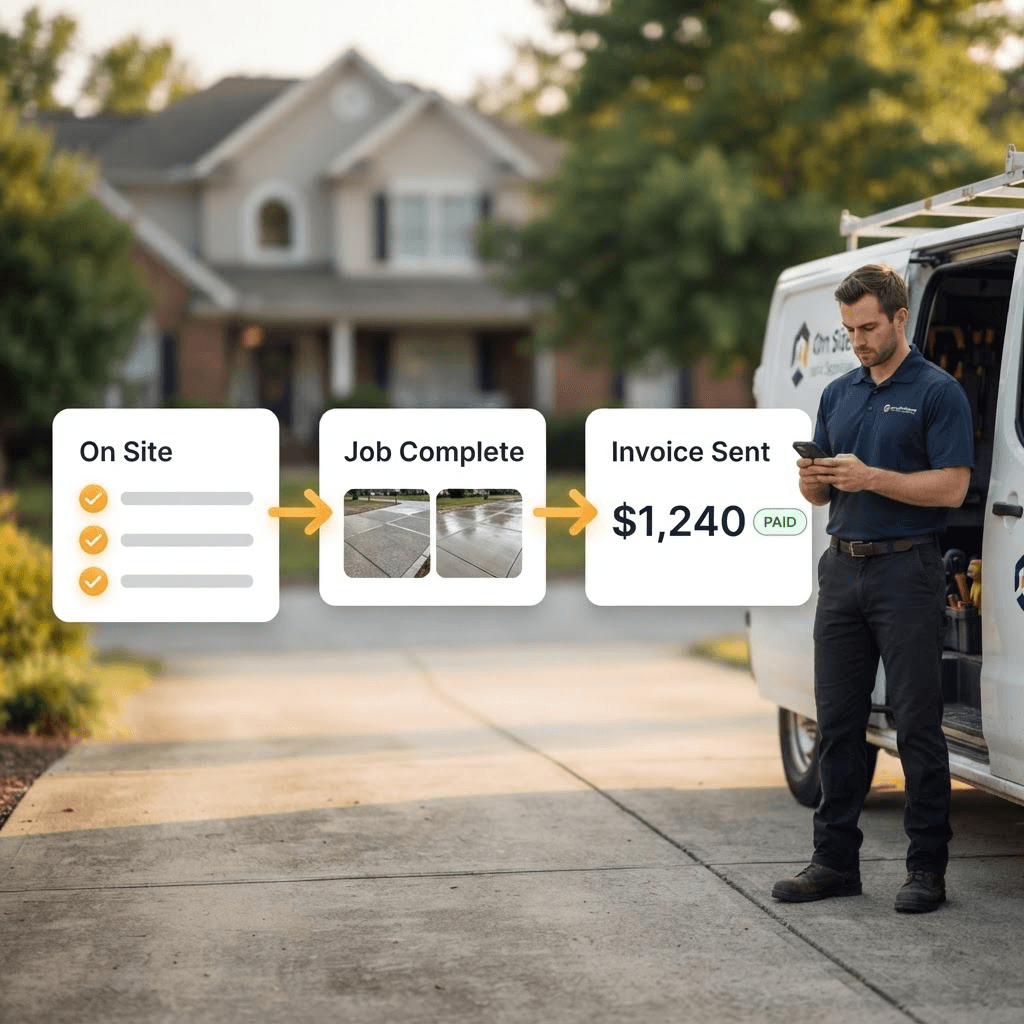
- Field crews need job details, checklists, photos, or signatures away from a desk
- You are re-entering the same information into two or three systems by hand
- Loyalty, reordering, or subscriptions would measurably lift repeat revenue
- You have a real budget for ongoing maintenance, not just the initial build
Probably not the right fit if
- A mobile-friendly web page or booking flow would achieve the same outcome
- Customers buy from you once or twice a year and would never keep it installed
- You want an app primarily because competitors have one
Outcomes
The business outcomes we build for
We only take app projects where we can name the outcome in advance. These are the returns that actually justify one.
Labor hours
Time returned to revenue work
The most reliable app payback is internal. Removing a repetitive daily process gives your team hours back every week, and those hours go to work that earns instead of admin that does not.
Error rate
Fewer expensive mistakes
Structured input, required fields, and validation catch the wrong address, the missed signature, and the mis-keyed price before they turn into a return trip or a write-off.
Repeat purchase
More frequent orders from existing customers
For businesses customers use often, easy reordering, saved details, and loyalty mechanics lift purchase frequency from the customers you already earned.
Speed to complete
Jobs closed out same day
When crews can finish paperwork, photos, and sign-off on site, invoicing happens sooner and cash arrives faster instead of waiting on end-of-week catch-up.
Data quality
One accurate record instead of three partial ones
An app wired into your real systems ends double entry, which means your reporting finally reflects what actually happened in the business.
Owned asset
Software that is yours
You own the code, the repositories, the store accounts, and the data. There is no per-seat licence that grows forever and no vendor holding your operation hostage.
The process
How an app engagement works
Deliberately front-loaded with the questions that stop bad projects. The first phase can end with us recommending you do not build.
- 01
Feasibility and payback review
We define the outcome, check what your current tools already do, estimate the labor or revenue impact, and give you an honest recommendation — including not building.
- 02
Workflow mapping
We document the real process step by step with the people who perform it, because the way work actually happens is rarely the way the org chart says it does.
- 03
Scope and prototype
We agree on the smallest version that delivers the return, then design clickable screens you can test with your team before any code is written.
- 04
Build and integrate
We develop the app and connect it to your CRM, scheduling, payment, and invoicing systems, with authentication and permissions appropriate to who uses it.
- 05
Pilot with real users
A small group runs it on live work while we fix what reality exposes. Every app design contains assumptions that only real use will correct.
- 06
Launch and maintain
We handle store submission where relevant, train your team, then keep it current against operating system updates and measure it against the payback target we set.
Capabilities
What is included
Scoped to the workflow that carries the value. Not every project uses every capability.
Feasibility and payback analysis
An honest assessment of whether an app earns its cost, before you commit budget to a build.
Workflow and process mapping
Documenting how the work really happens, which frequently improves the process before software touches it.
Product design and prototyping
Clickable screens your team tests early, so expensive changes happen in design rather than in code.
Mobile app development
iOS and Android builds for customer-facing or field-team apps, including offline handling where crews lose signal.
Web app development
Browser-based internal tools and dashboards, which are usually the faster and cheaper right answer.
Systems integration
Connecting to your CRM, scheduler, payment processor, and accounting so data lives in one place.
Authentication and permissions
Secure sign-in and role-based access so people see only what their job requires.
Maintenance and iteration
Ongoing updates, monitoring, and improvements measured against the payback target we agreed on.
How we work
How we work, and what we will not claim
App development is where small businesses lose the most money to vendors who never questioned the brief. We would rather lose the project.
We will talk you out of it when we should
A meaningful share of app inquiries end with us recommending a web page, an automation, or better use of software you already own. Saying so costs us the bigger project and saves you far more.
You own the code and the accounts
Source code, repositories, app store listings, and data are yours from the start. You can take the project to another developer at any point without asking our permission.
Fixed scope, staged commitment
You approve a defined scope with a fixed range, and you commit in stages. If the feasibility review says stop, you have spent the cost of the review rather than the cost of a build.
No maintenance surprises
We tell you the ongoing cost of keeping an app alive before you start, because that number is what makes or breaks the decision and most vendors leave it out.
FAQs
Frequently asked questions
NOT SURE THIS IS YOUR BIGGEST PROBLEM?
Find the biggest leaks across your entire marketing system.
Three minutes, 21 questions, and a prioritized diagnosis. If the answer is not this service, we will tell you that.
Related services
Where this fits in your growth system
An app is rarely the first thing a business needs. These are the services that usually earn more, sooner.
Websites & Landing Pages
For most small businesses this achieves the goal an app was supposed to, faster and for considerably less money.
Learn moreCRM & Marketing Automation
Many requested app features already exist here. Configuring your CRM properly often removes the reason to build.
Learn moreCustom AI Systems
When the goal is removing manual work rather than shipping an interface, this is frequently the better investment.
Learn more
Find out whether you should build at all
We will review what you want the app to do, what your current software already handles, and what the realistic payback looks like. If the answer is that you should not build one, we will tell you and point you at what to fix instead.